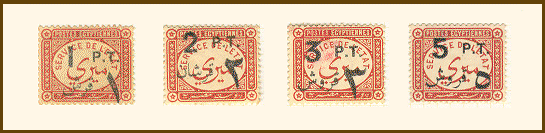
This stamp was issued for franking all inland official mail regardless of its weight or whether registered or not. It did not apply to parcels. During the long life of this issue, from 1893 to 1914, many changes took place either in paper type, sheet arrangement, or watermark.
On un-surfaced paper in sheets of 240 stamps (4 panes of 60) with watermark wide crescent and star Wmk. 5a (upright). Each pane was surrounded by a solid (continuous) buffer line.
On chalk-surfaced paper in sheets of 240 stamps (4 panes of 60). Each pane was arranged 6 x 10 with same watermark (Wmk. 5a). The surrounding buffer was changed to an interrupted (coextensive) buffer bar.
On February 1st 1907, a new set of official stamps was issued based on the De La Rue stamps overprinted "O.H.H.S." and in Arabic miri (official), so the no value stamp became redundant.
Re-introduced on January 1st 1909, same as the 1903-1907 printing, but the stamp was used only to frank unregistered internal official mail (correspondence). For registered, insured or parcels, stamps of the 1907 issue were used.
On chalk-surfaced paper in sheets of 600 stamps (6 panes of 100). Each pane arranged 10 x 10, the panes were arranged 2 x 3. The watermark was changed to narrow Crescent and star Wmk. 4c (sideways). A buffer bar also exists around each pane in addition to multiple pillars in gutters between the four panes.
The remaining stamps were overprinted in Typography to be used as fiscal stamps on documents.
The surcharges were in Arabic: 1 P.T., 2 P.T., 3 P.T. & 5 P.T.
Some stamps were used on official mail covers (seen from 1919 to 1922); it seems to have been used to pay the simple letter rate of 5 millièmes despite the overprinted face value.